My time with: Middle Earth: Shadows of War

I bought this because it was cheap and I remember vaguely enjoying the first one. The best way I can describe it is Assassin’s Creed with a Lord of the Rings skin. It’s a game about fighting and climbing fast-travel points to reveal lots of things to collect and missions to do. 

It’s Nemesis system is the best thing about it, orcs that have personalities and grow stronger if they defeat or escape from you. In my opinion that’s the only thing this game does that stands it above anything else. Even that becomes a chore. I loved murdering captains to get info on warchiefs and then murdering them to assault a castle and take it. I loved it once, but when you have to do it 4 or 5 times it’s just busy-work. The story missions are mostly completed in 5-10 minutes and then you’re back to the day job of stabbing Orcses. 

If you’re a fan of Lord of the Rings lore then you need to be able to set that aside if you want to enjoy this game, it very much makes it up and makes some changes that are not Tolkienian in any sense of the word. Isildur is revealed as a Nazgul, even though the first sighting of The Nine happened more than 1000 years before the battle of the last alliance and Isildur’s downfall.

In the first 10 minutes we’ve seen your character forge a new One Ring and seen Shelob, last spawn of Ungoliant as a sexy lady giving you visions of the future. Having forged that Second Ring, we find out that we get betrayed by things we’ve dominated before for no reason and encounter orcs that cannot be dominated near the end. It’s an inconsistent mess. 

The future is where we run into another problem. We know that in the future Sauron dominates Mordor and moves to assault Middle Earth. Here we are in game, trying to liberate Mordor from him and depose him, which we know fails. It makes it all seem a bit pointless.

The end of the game tries to frame this in some way that doesn’t work in my opinion. Celebrimbor betrays you and tries to fight Sauron, he loses, you die and become a ringwraith and are told to conquer Minas Morgul. When you’ve spent 25 hours dominating orcs to build an army to defeat him and the game ends with – ah sorry no – you need to go to this green place and stay there forever, that’s not a twist as much as it is breaking the ‘promises’ that the game made to you in the beginning.  

I can’t recommend it honestly as the game exists in such a strange place. If you like Assassin’s Creed, then play Assassin’s Creed. If you like Lord of the Rings, this game will most likely be quite annoying and you’d be better off playing Assassin’s Creed. Bottom line, it doesn’t do enough better than Assassin’s Creed and does lots worse. I paid £6 and still think it was a waste of money.

How to read The Lord of the Rings

The title may seem ridiculous but the fact is many people struggle with reading Lord of the Rings in full, they often give up. I think, for newcomers or people who have tried to read it and failed, it  may be of benefit to take a new approach. I find that I appreciated it a lot more once I understood exactly what Lord of the Rings is.

Despite fathering modern fantasy as we know it, Lord of the Rings was not intended to be a fantasy story in the same way. What Tolkien was writing is closer to folkloric inspired mythology. Tolkien intended to give England specifically a mythology that it doesn’t have, especially when compared to other countries like Greece for example. 

The book exists within its own fictional frame. To put it simply, the story you read when reading Lord of the Rings is The Red Book of Westmarch, Bilbo’s and Frodo’s accounts of their adventures, curated by Tolkien. If you look at the recent Stephen Fry retelling of the Greek myths, that’s similar to what we have here, Tolkien is being the historian to The Red Book of Westmarch. 

This means that if you go into the Lord of the Rings expecting a modern fantasy novel, it’s going to be disappointing. There aren’t many fast, furious action scenes or as much character development, as real life doesn’t follow that pattern and hasn’t been edited to fit into the mould that modern fantasy readers want. Lord of the Rings is far closer to Beowulf or The Odyssey than it is to Brandon Sanderson or G.R.R Martin. 

If you’re reading A Long Expected Party, and thinking: “Get on with it, when will the action start?” you’re going about it the wrong way. Tolkien spent his life writing and rewriting The Lord of the Rings, there is no accidental word, sentence or paragraph. Everything is intentional and has a purpose. 

Go into it like you’re reading about Zeus, Perseus or Odysseus instead. My most recent ‘re-read’ of Lord of the Rings was through the fantastic audiobooks read by Robert Inglis, and just sitting back and letting the story wash over me, enjoying the language and the vivid description. I would whole-heartedly recommend this as a place to start.

There is one thing I would say however and that is to skim through The Council of Elrond on the first pass. This chapter is famous for turning readers away due to it’s very long explanation of the world’s history up until this point. While it adds tremendous depth and weight to the quest of the Fellowship of the Ring, it isn’t vital that every reader digest it all and get confused by the many names straight away. It will still be there on your second or third reading and you can enjoy it then when or if you have an interest in the wider history. 

I am convinced that if people approached it differently as outlined above then it will ‘unlock’ for them instead of having the reader fighting against it expecting a modern high fantasy novel. 

On a personal note I have found so much in the book that helps me in terms of dealing with anxiety/mental health issues. I don’t have room here to dive into that whole topic but most basically it taught me that if you endure through difficult times, you leave room for opportunity to reveal itself, and that there is value and meaning in the struggle. 

My time with Torment: Tides of Numenera

Torment: Tides of Numenera was released in 2017 and was the self-confessed spiritual successor to 1997’s masterpiece Planescape: Torment. I’m not sure why it took me until this last month to play it, perhaps I was worried somehow that it wouldn’t live up to the expectations I had. Planescape is my favourite game of all time and I regularly go and replay it. I think Tides of Numenera slightly misses the point of Planescape, and would have been a far better game without tying itself to the name. 

Tides of Numenera has you playing as a former avatar of the Changing God, a discarded shell now given agency and an individual life. I think here is where problems begin. While addressing similar depth and ideas of a long immortal life, in Planescape all those lives are you, you are personally responsible for all the actions of your previous lives, there is no passing it off to being possessed by the malevolent god. 

There is a moment in Planescape where you are forced to confront just how evil some of your previous incarnations have been and you have no choice other than to feel all the pain you have caused others and break down in tears. It’s absurdly powerful storytelling and something that Tides never really reaches. Numenera has you acting out a ‘save the world’ story where, rather confusingly, you aren’t the only former host of the Changing God running around, you meet many in the game which rather more confuses the plot, I was wondering why I was saddled with the burden and why someone else couldn’t do it instead. 

Planescape was all about your character finding out who you are. The single largest experience gain in Torment is finding out your own name, the player doesn’t even know what it is, but your character does. The NPC’s and party members are broken, conflicted people all with real-life issues. Planescape echoes real life issues in a fantasy setting where Tides plays out a story that can completely wash over you. 

I personally found the language very confusing. Instead of Mage, Fighter, Thief we have Glaive, Jack and Nano. Instead of spells we have esoteries and instead of buffs we have fettles. We have oddities, artifacts, cyphers and all manner of confusing things. I’d never come across the Numenera world before so maybe it’s my own fault but I find it immersion breaking. It’s not as if there are any actual changes either to justify the language, it’s just a skin placed on top of already familiar mechanics and ideas. 

I think if the game was called Tides of Numenera it would have been a lot better. By attaching Torment I’m coming from the expectations of the masterpiece and there’s only one way to go from such heights. Judging the game for itself would have given me a far more positive impression of it, I would have enjoyed it for its own merit. While playing Tides of Numenera all it did was make me want to play Planescape: Torment again, after all, what can change the nature of a man?

My time with Salt & Sanctuary.

I have had Salt & Sanctuary installed on my PC for a long time and never gotten around to playing it. I was hesitating for some reason, either a fear that I wasn’t going to be good enough to play it or of perhaps their addictive quality. A week or so ago I dived in and sure enough this ‘Soulslike’ has absorbed all my gaming time. 

I dislike the term ‘Soulslike’ as for me it’s often so vague and doesn’t always mean that the qualities that made the Dark Souls games so captivating are present. A game can call itself Soulslike for only having a mechanic that punishes you on death for example and share no other similarities whatsoever. Lords of the Fallen would be a good example of this. For me what made Dark Souls and Bloodborne so amazing were the combination of a whole host of different features, themes, mechanics and ideas.

I think I’m about halfway through and in my opinion this is one of the better Soulslike games out there. By that I mean it feels the most like Dark Souls, in fact it was called the 2D Dark Souls in a number of reviews and I think it’s mostly gotten there. In terms of atmosphere, interconnected level design, music, upgrade systems, combat and scope it feels like Dark Souls. I feel desperate to make it to the next sanctuary to not lose my acquired salt, I feel the dread of every new area and boss and the greed for the last strike to down a boss where I should jump back and heal. 

One way in which the game isn’t quite up to the mark is in the lore. Some of the Dark Souls lore has been the most beautiful storytelling I’ve come across in gaming. Perilously close to Tolkienian levels of depth. I’m not saying there is no lore in S&S but I’ve not discovered anything that comes close to even the more minor plotlines in Dark Souls or Bloodborne such as Pinwheel or Gascoigne. 

I don’t particularly find the bosses to be that difficult either. Many of them so far have been a case of equipping the right items and stat effects and being ultra aggressive, very rarely have I come across a boss that has taken me more than 3 attempts. Compare that with the Orphan of Kos from Bloodborne, the Fume Knight from Dark Souls or the Demon of Hatred from Sekiro and you’re dealing with bosses that are difficult even with late game knowledge and items. Many other 2D side-scrolling games have far higher levels of challenge and don’t call themselves Soulslike and yet one that does is frustratingly lacking in that key identifier. 

I’ll complete it and enjoy it and think fondly of it, but I don’t think I’ll ever replay it. Which is fine, not every game has to be a masterpiece, but I think by adopting or allowing the comparison with Dark Souls you are, in a way, elevating the expectations of the players. 

I’ll shortly be reviewing a game called Torment: Tides of Numenera which shares the same flaw. The game was advertised as a spiritual successor for Planescape: Torment, my favourite game of all time and by attaching that reputation it fails in living up to it. An expectation I wouldn’t have even had if they had just called the game Tides of Numenera. It’s a subtle thing but it shifts your position from which to think about the game. Call a game a Soulslike and I’ve come down from the top with expectations I won’t fall far. Let me approach a game from below and I’ll likely feel more positive coming up to it. 

Salt and Sanctuary draws heavily from Dark Souls and that is both a blessing and a curse, it gets very close and probably would have been better for taking more of a sidestep away from the Souls series. I think it is a really good entry place for anyone looking to get into Dark Souls that has been too cautious to do so. 

Having said all this, would I have even played the game without the link to the From Software legacy? It’s a frustratingly complex idea to discuss and think about as I predominantly played this game looking for that Dark Souls feel and I think overall I did get it.


The social media argument; An unrewarding waste of time. 

I am an argumentative person and I love debating and arguing with people. I find it a great test of mental gymnastics unlike any other, needing to cover your opponents points and think of counterpoints in the moment is an enjoyable experience for me. I also find it a vital way to double check my own opinions and beliefs. If I cannot overcome someone’s counterpoints to my belief and don’t have many things to offer it really shows up where my knowledge is lacking and makes me take a look at what I consider to be true. I love being wrong, I love finding out how I was wrong, why I was wrong and researching it to maybe have a better point next time.

Social media then for me should be a delight, almost at any hour of the day I can get myself in an argument about something. I have found though, that the process is remarkably unfulfilling and frustrating due to a number of factors that I shall try and cover here. 

There is definitely a lack of humility on the world of social media, rarely will you hear someone in a long argument thread say something like “Wow, I didn’t know that, I was totally wrong!”. This seems to me to be part of a wider trend in society that people cannot detach their beliefs from their identity, they take an attack on an opinion to be a personal attack and so cannot simply let it go but respond. Instead of the admission of a lack of knowledge or a misunderstanding they will double down, often getting emotional, defensive or insulting.

The medium of social media itself also tends to lead to a more incendiary atmosphere. I’m far less likely to be abusive or insulting to someone in real life where I can see their facial expressions, the effects of my words or perhaps feel their physical counterattack if pushed too far. Text is dehumanising, text is nothing, it’s easy to be mean to a piece of text. Coupled with the anonymity that I’m likely to never engage with the person again creates a scenario where I don’t need to inhibit my language or tone to prevent offense, nor do I have to abide by the rules of civil discourse by not being insulting or rude. Most social media arguments therefore are conducted in a context where not all parties agree to not escalate the situation. 

One of the most frustrating things I have found is what I call the “prove me wrong or I’m right” -ers. They will appear somewhere and make a claim but refuse to provide any evidence to back it up, instead they will hold the position calling for people to disprove them. After having received some piece of research or something they will then find the most trifling reason to discredit it and continue to sit atop their throne of infallibility without anyone being able to prove them wrong. The logical fallacy here is fairly straightforward to unpack. If someone were to argue that the earth is flat, I do not need to prove to them that it isn’t. Prevailing wisdom suggests that it is. They need to prove to me that it is not. 

A second type of twitter argument is waiting for you to give up and then claim victory. It sounds childish and nonsensical written like that but it is mind-breakingly common. Usually the more reasonable of the participants will realise the argument is going nowhere and choose to discontinue. The other participant will then claim victory because they are “tapping out” or “have nothing else to say”. Again the logic here is fairly baffling, those who partake in this tactic will stick to this as if their life depended on it, even when the conversation as wildly veered away from it’s initial premise. If I was on a bus arguing with someone denying the Holocaust, my having to get off the bus at my stop doesn’t mean the Holocaust didn’t happen, it means I need to end the conversation. Frustratingly obvious, but one of the most common things I see happen. 

I’m no psychologist, but in this I see desperation for contact. My life is such that I have several “pillars” of things that are going well. My fear is that many people haven’t worked to achieve that and so place higher importance on their social media lives. It takes me placing a level of importance on what someone says to argue with them, I’ve read it and considered it and then replied. I genuinely think people are so hostile on social media because they are desperate for interaction.

Thirdly, I’ve noticed a fairly simple tactic that everyone will have seen; the straw man. The idea by which someone will respond with a counterargument to a point that you don’t hold or haven’t said. Again, whenever I’ve had these arguments they tend to devolve to me continually re-quoting my actual views as the other participant  desperately tries to have a totally different argument. These tend to be fairly easy to shut down as they don’t have much momentum in themselves: “So what you’re saying is…” can be easily answered with “No. I didn’t say that at all, please re-read my post.” 

The echo chamber factor is another element to the social media argument that covers a number of things. Someone will say something silly and not actually respond to your counterpoint, instead replying with a gif and revel in the “likes” claiming victory through the interaction of their followers. Some will begin their own arguments with you at some point through the chain of a different argument over the use of a word or idea, completely out of context of the main debate. The depressing thing here is as an outsider arguing with a cult, (sorry echo chamber) is that numbers count, you’ll be shouted down and mocked no matter the validity of your argument, it simply won’t be addressed if it contradicts the edicts of the group. 

The final group I’ll mention is the “insulters” or to show off a bit of Latin here: “argumentum ad hominem” meaning “to the person”. These are the ones who once you have suggested they are wrong, will just insult you. Rather more irritatingly they will rarely realise or accept that by resorting to this tactic they have, by any metric, lost the debate. They will instantly shift from the point of debate to straight insult, finding something on your profile to mock or insult, or just insulting you directly. Many of these will also be the echo chamber argument intruders mentioned above. 

A debate or argument is almost like a duel at dawn in my mind. An arrangement that two parties enter, both knowing the rules and protocol involved and agreeing to carry them out. Social media is like a duel where one participant has no idea of, or intention to stick to the rules. To carry on the metaphor, I take my 10 steps and turn to discover they have built a wall and gathered a few friends to form a firing squad. 

My personality is nauseating enough that I shall continue to ask for evidence of spurious claims and to inject context into the propaganda campaigns of echo chambers. For that I will likely never have a decent debate again, instead I shall endure comments like “ok boomer”, “haha why you so mad bro”, “triggered much?” and other perfect examples of the degradation of the English language. 

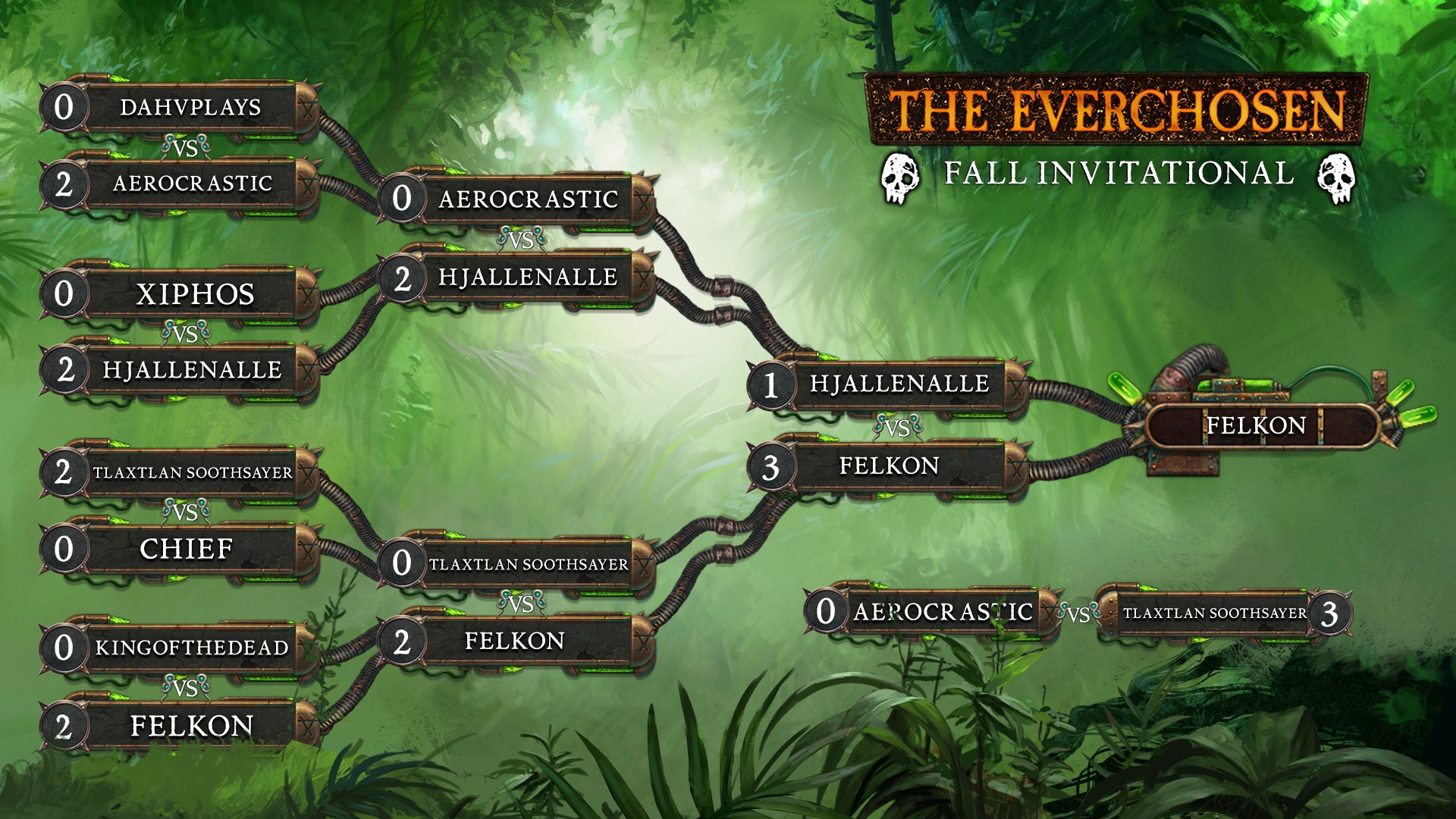
TW:W2: Felkon ascends to the throne of the Everchosen by winning the 5th iteration of the event.

EHV_W5NXkAIwgCo.jpg
Picture credit: Creative Assembly

On the path to the title he defeated the reigning Everchosen champion Tlaxtlan Soothsayer. He was joined in the final by HjalleNalle a new player invited to the tournament who took it by storm, getting to the final without dropping a single game. It’s fantastic to see new players coming to the tournament and doing well. It’s also good for the game to see new Everchosen champions.

In the first battle of the competitive final HjalleNalle played Greenskins into Felkon’s Norsca, he brought a mass of Orc Arrer boyz and used them to great success as he spread them wide and picked apart the slower Norscan advance after eliminating their skirmish units. 

In the second map, Hjallenalle took Lizardmen into the Wood Elves of Felkon. Hjallenalle had done his homework on Felkon and how he likes to play Wood Elves with use of Wild Riders and Forest Dragons, and picked a strong counter to that style of play focusing on aerial units. Unfortunately, Felkon completely flipped the script and brought a vast army of mostly tier 1 archers. These archers wiped out most of Hjallenalle’s vanguard deployed air force almost immediately. Having removed that value from the map, Felkon could focus fire down the remaining expensive units. Despite some excellent engages from Hjallenalle to try and bring it back there was just too much volume of fire to deal with.

Felkon took the lead 2-1 by convincingly winning the third map. He played Lizardmen versus Hjallenalle’s Beastmen. Felkon brought a Slann mage priest of light with Temple Guard and some long range artillery to focus down the beastmen single model units. Use of Birona’s Timewarp buffed up the front line Lizardmen units to be almost unkillable. The Beastmen giants did manage to pick the stegadon  and do some damage but the massive units of infantry remaining managed to clean up the fight with Felkon’s army only losing 188 models. 

The final map was Felkon’s Dark Elves versus Hjallenalle’s Chaos. Felkon brought his favourite unit The Chill of Sontar and used his elite infantry to screen while his repeater crossbow cavalry were able to pick apart Hjallenalle’s army. Whenever Malekith was getting focused he would send him into combat supported by that core of infantry that was never far away.

Creative Assembly hosts these invitational tournaments after major content drops, and this Fall Invitational comes weeks after the Hunter and the Beast DLC pack. 

The regular on screen talent of Turin, Italian Spartacus and Loremaster of Sotek were joined by newcomer PartyElite, who hit the ground running maintaining the high quality commentary and analysis that Total War fans have come to expect from Everchosen streams. The broadcast was as entertaining and insightful as ever. 

Total War: Warhammer 2 provides a unique esports experience with fast paced yet incredibly tactical battles, varied races and a plethora of talented casters and players. It’s great to see Creative Assembly putting on these events and investing time into the competitive side of their product.

Richard Lewis forced to share fictional writing to prevent it being used against him out of context.

Veteran esports journalist Richard Lewis, winner of the 2016 Esports Journalist of the Year award, has revealed a previous interest in creative writing and fictional work in order to stop the material being used to blackmail him. 

In a stream on October 16, Lewis spoke about how he was made aware of a group of journalists who were going to use this material out of context to attempt to do the most damage to his reputation. The stream was focusing on showcasing the abuse that he had received having blocked over 100 members of the Overwatch community. 

During the stream, Victoria Rose from Fanbyte tweeted the message “Get off my feed or we’ll share your old WordPress”. This WordPress blog is a platform that Richard used to develop his passion for creative writing, and display segments of a novel to share with friends. Having had no audience since 2011 Lewis noticed a spike in traffic to the site around August this year. The intent of those who would use the material would be to take this fictional work out of context and present it as truth that Lewis believes. The blog contains segments of a novel called The Romantic.

“The Romantic, was about a chauvinistic, bitter drunk who worked in a call centre and was miserable and the only way he could feel a connection to real life anymore was basically by seducing women but doing it with really horrible cynical means, and it was an ironic title because obviously there’s nothing romantic about that.”

During the stream Lewis showed screenshots of emails to publishers, published writers and previous girlfriends sharing sections of the work as evidence that it was indeed fictitious. In the interest of full disclosure and to remove the threat of blackmail, Lewis then read aloud the “most incriminating” sections. He did so to remove the power anyone had over him in using the material for blackmail stating; 

I always believe that, when people are blackmailing you and doing it so brazenly, that you have to neutralise the power. You can’t let people blackmail you for things, especially things, that you do not have to be ashamed of.”

Lewis shared the link to the already publicly viewable blog and encouraged viewers to read the entries for themselves. In order to get to the extracts mentioned, a user will have to scroll past journalistic works on the same site. This change echoes the change in direction of Lewis’ career moving more into journalism away from the creative writing. Any user can see therefore, the change in style dictated by the differing purpose of the work be it fictional or journalistic in intent.

In making all this public, Lewis has been clear that he will not be blackmailed and has gone on the record to prove that this material is fiction and should not be used as direct quotations from the author himself.

“I’ve got e-mails from the time proving they are fiction, I can put you in touch with fellow writers, publishers that reviewed and assessed this fiction, I have the original manuscript over there, I can release original unedited copies of the work, I can release the novel as it is to this day, which is, you know, a good ten-thousand, maybe twenty-thousand words, so you can even see the reason it was abandoned.”

At time of writing there has not been any pieces released by journalists using this material as direct quotations. Richard Lewis has urged fans to share an article he has written for Dexerto detailing the position he is in, regarding routine abuse and harassment he is subjected to by people who claim to share in his profession.

Rugby Union: World Cup 2019 – Pool Stage Review

Wales 43 – 14 Georgia
Wales 29 – 25 Australia
Wales 29 – 17 Fiji
Wales 35 – 13 Uruguay

Surface level analysis would conclude that Wales are heading into their quarter-final against France in strong form. They have won all their games in Pool D of the tournament. Unfortunately as with all things, the reality paints a more complex picture. Wales have looked stronger than their warm up games would suggest. They are probably favourites to beat France in the QF, but as a fan I’m somewhat underwhelmed.

The most recent match with Uruguay featured 13 changes to the team and rested some key players, as always with Wales, lots of changes resulted in a mess frankly. Wales were inaccurate, with so many passes going behind players or going to ground, and a fantastic performance from Uruguay made them look far more challenging than the difference in the world rankings would suggest. Emblematic of this were two disallowed tries due to two forward passes, simple errors that cost points.

This alludes to there still being a gulf between the probable players and the possible players. Wales appear to be dangerously on the edge with one or two injuries being all it would take to derail the high level of execution the game plan demands.

Against Australia, Wales were amazing in the first half but then didn’t do much else but defend for the final third (heroically admittedly), but for a moment it looked like at some point Australia were going to break the red wall again and sneak the game. Wales seem determined to kick the ball away no matter what and “trust their defence” I just wish they would hold onto the ball longer and play the final moments in the opposition half, not camped on their own line.

Wales were also given a fright against, Fiji who played really well and tore the Welsh defence apart. For the neutral these games were fantastic, but for me Wales should have enforced their will on their opposition rather more emphatically, especially versus Fiji and Uruguay.

The Welsh game plan is based around a high level of execution. Kicking, claiming the ball in the air, getting the defensive line up correctly etc are all basic skills of the game that teams will emphasize, but for Wales they all need to be there for the machine to start grinding out points. You only need to look at the Uruguay game to see how the plan falls apart when the basics are missing. We have lost a bit of the flair for a more pragmatic, approach.

Wales should have enough to beat France who are hilariously inconsistent. I expect the Welsh defence to stifle the France attack and force lots of mistakes for Wales to set up camp in the French half and start racking up points. Overall I cannot really complain as Wales have won all their pool games and will face France instead of the far trickier England. I am pleased, but the games were not ones I could sit back and relax in that’s for sure.

Wales vs England World Cup Warm Up #1

Wales 19 – 33 England

On paper this looked to be a very simple affair for Wales, they were coming in to the game having won a Grand Slam and on a 14 game winning streak. Due to Australia beating New Zealand, Wales stood to become the #1 team in the world by winning this game. England on the other hand were fielding a team of outsiders, players who were not mainstays of the starting XV but who were getting a chance to create some selection headaches for Eddie Jones.


They managed to do exactly that. England piled on the pressure early on with some quick scores and never really let go of the advantage. The English forwards were dominant in the scrum and around the fringes.


The Welsh by comparison looked tired. They have been enduring a reportedly grueling fitness camp in Switzerland and it showed. There was no line speed in defense, no English player getting hammered backwards in contact and not a great deal happening at all. The lineout was horrendous, wasting an opportunity for one try and gifting an opportunity for an English try.


There is no where really to turn, Wales were thoroughly beaten, their only period of dominance came alongside a succession of English penalties.


Both teams will repeat this test this weekend, only this time doing so in Cardiff. Wales have lost Gareth Anscombe to injury for their World Cup campaign and now need to quickly find a backup for him.


Whatever the result, England looked to gain a lot more than Wales. Even if Wales won it wouldn’t have shown us much, yes the Grand Slam XV beat a second string England team, congratulations. England however, tested lots of players and some, like Tom Curry and Jonathan Joseph performed spectacularly.


It will be interesting to see selection for the game in Cardiff. Will Gatland try and prevent the 0-2 to England or will he risk it and try out some different players?


No one will remember these warm up games, they are more to get players match fit going in to the World Cup seeing as all the southern hemisphere sides will have just completed The Rugby Championship. It was depressing as a fan however to see such a lethargic and inaccurate Welsh performance.